 DNS Unpacked
Who runs domains: registries, registrars and ICANN
The short version
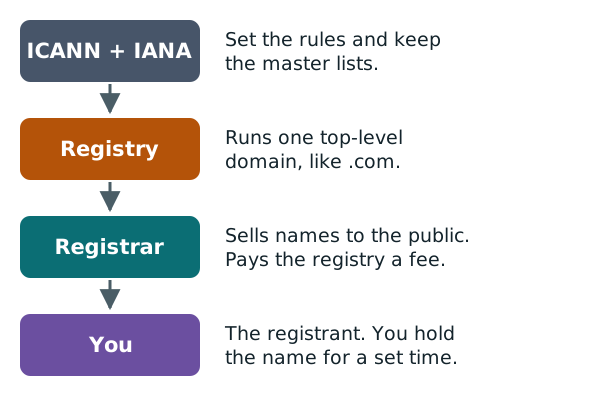
- ICANN sets the rules for the whole domain system.
- IANA keeps the master lists, including the list of every top-level domain.
- A registry runs one top-level domain, such as
.com. - A registrar is the shop that sells you a name under that domain.
- You don't buy a domain forever. You register it for a set time and renew it.
ICANN sets the rules
ICANN is a not-for-profit group, formed in 1998. Its job is to keep the internet's names and numbers safe and working together.[1]
ICANN does not decide what goes on websites.[1] It looks after the naming system that sits underneath them.
It does this mostly through contracts. ICANN signs a contract with each registry.[1] It also decides which registrars are allowed to sell names in the generic top-level domains.[1]
IANA keeps the master lists
Some things on the internet must mean the same thing everywhere. A domain name has to belong to just one party, all over the world.[2]
IANA keeps the official lists that make sure of this.[2] One of them is the list of every top-level domain, which you met in the last chapter.
Today, IANA's work is done by a group set up by ICANN just for that job.[2]
A registry runs one top-level domain
Each top-level domain has one organisation in charge of it. That organisation is called the registry. It keeps the full list of every name registered under its domain.[1]
Some examples from IANA's list:
- The
.comregistry is run by VeriSign.[3] - The
.auregistry is run by .au Domain Administration, or auDA.[4]
You normally never deal with the registry yourself. You deal with a registrar.
A registrar sells you the name
A registrar is a business that sells domain names to the public. Many registrars compete with each other. Each one sets its own prices. For each name it sells, it pays a set fee to the registry.[1]
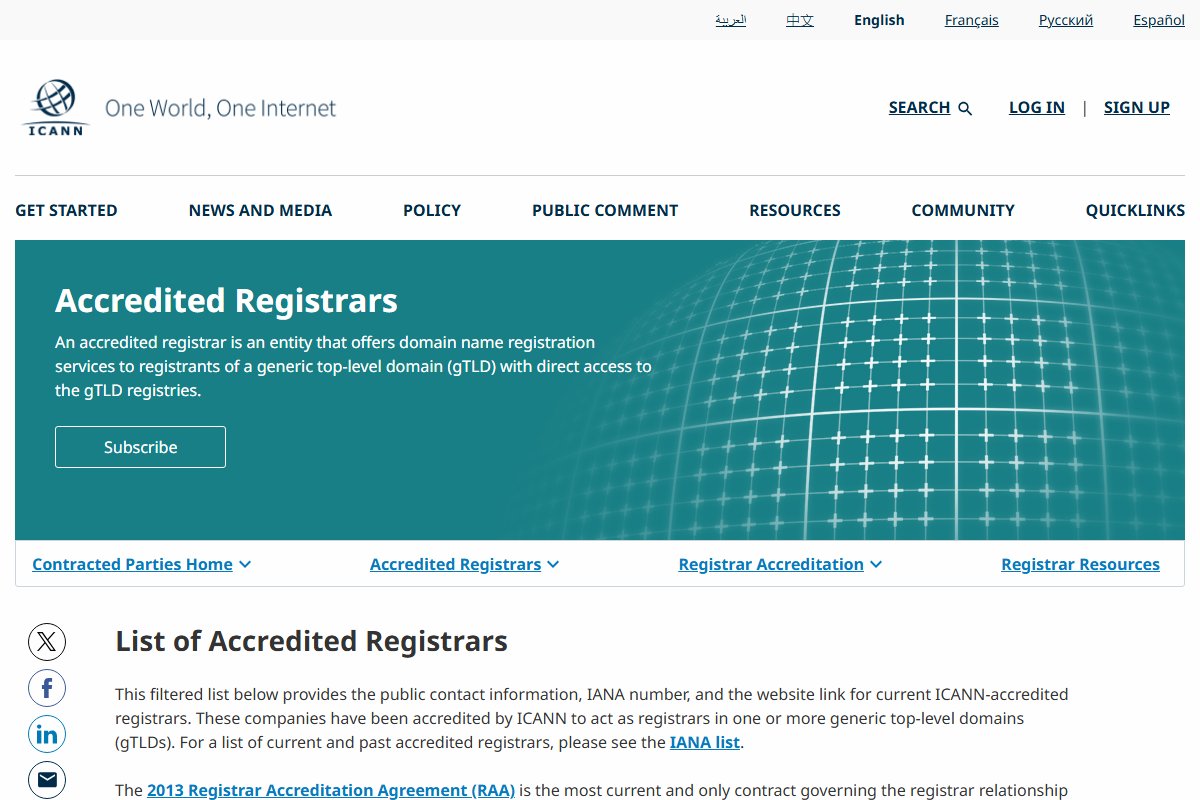
For the generic top-level domains, a registrar needs ICANN's approval. This approval is called accreditation. An accredited registrar can deal with the registry directly.[5]
ICANN publishes the list of approved registrars on its website:
Country-code domains, like .au, usually have their own approval process.[6]
Some shops sell names for a registrar without being one. These are called resellers.[6] A web host that sells you a domain may be one of them.
You are the registrant
The person or business that registers a name is the registrant. When you register a name, you make a contract with a registrar.[7]
After that, the registrar is where you manage the name.[7] Changing the nameservers is one example. You log in to your registrar's site to do it.
Do you own your domain?
Not quite. You register it for a set time, and you can renew it before that time runs out.
For the generic top-level domains, one registration can last up to 10 years.[6] Many people choose one year at a time.
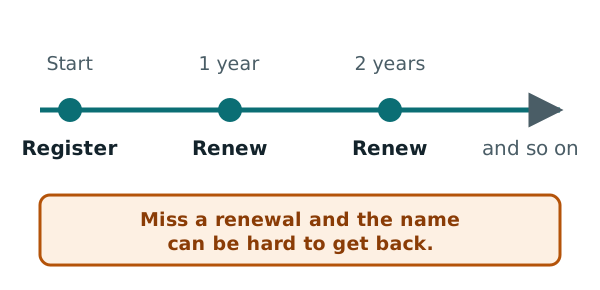
Renewing on time matters. If a registration runs out, getting the name back can be hard, costly or impossible.[6] ICANN tells registrants to keep their contact details up to date.[7]
Finding out who your registrar is
Sometimes you don't know where a domain was registered. A web designer may have bought it for you years ago.
ICANN has a tool for this. It is called ICANN Lookup, and it shows the registrar for a domain.[7]
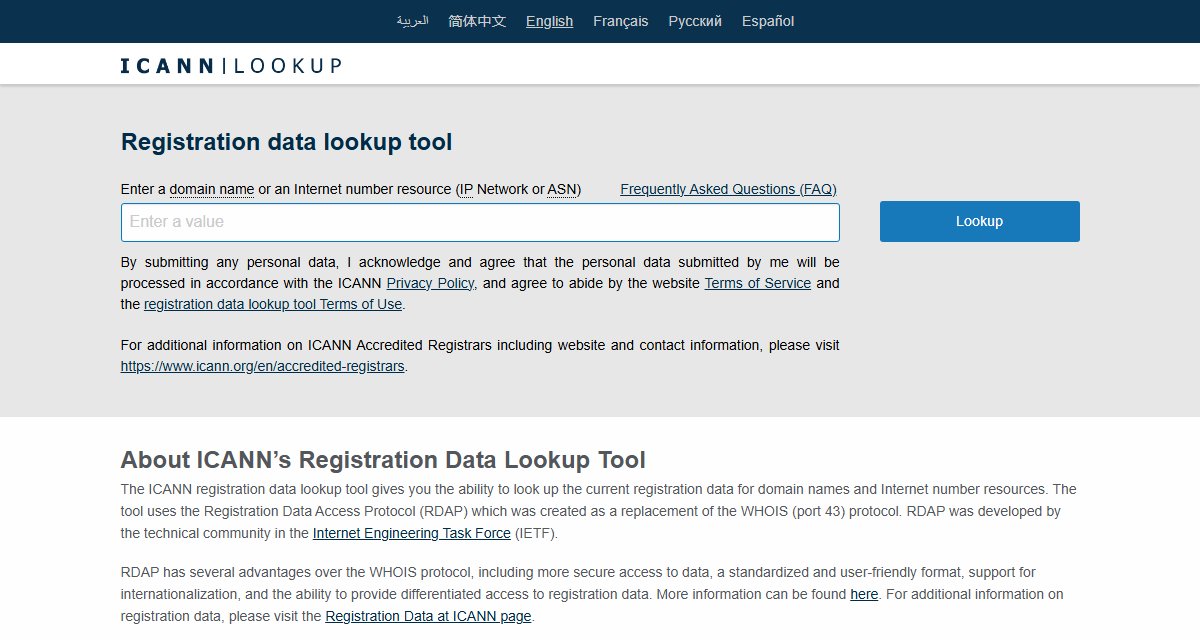
Type the domain into the box, then press Lookup. The result names the registrar for that domain.
Next: how a lookup works
You now know who keeps the lists and who sells the names. Next, see what happens when you type an address, and how a computer uses those lists to find a website.
Sources
- What Does ICANN Do?, ICANN (accessed 2026-10-18)
- About IANA, IANA (accessed 2026-10-18)
- .com Top-Level Domain, IANA (accessed 2026-10-18)
- .au Top-Level Domain, IANA (accessed 2026-10-18)
- List of Accredited Registrars, ICANN (accessed 2026-10-18)
- Domain name registrar, Wikipedia (accessed 2026-10-18)
- Domain Name Registrants, ICANN (accessed 2026-10-18)